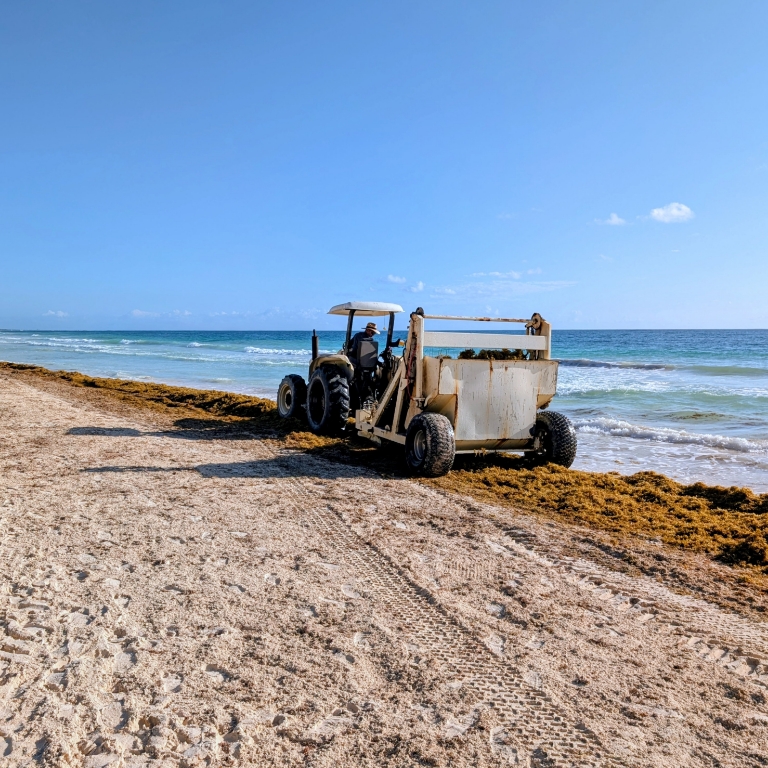
The Mexican government has taken a major step toward more efficient and sustainable sargassum management. With an investment exceeding 120 millon USD, it announced a comprehensive strategy aimed at reducing the impact of this macroalgae on the coast of Quintana Roo through prevention, technological innovation, and sustainable utilization.
The project marks a significant shift in how the sargassum phenomenon is addressed by prioritizing its capture on the high seas before it reaches the beaches. To achieve this, the plan includes the use of specialized vessels and containment barriers to intercept the algae offshore, thereby reducing its accumulation in coastal areas.
Another key pillar of the strategy is the creation of the first Circular Economy Hub for sargassum utilization in Puerto Morelos. This center will drive research and the development of processes to transform the biomass into products such as fertilizers, biofuels, and biomaterials, fostering new opportunities for innovation, investment, and economic development in the region.
The integration of satellite technology will enable real-time monitoring of sargassum patches, facilitating the planning of containment efforts and allowing for proactive action in areas most likely to be affected.
For the tourism sector, this strategy represents encouraging news. Coordination among authorities, scientific institutions, and productive sectors strengthens the long-standing efforts of hotels, service providers, and local communities to maintain the beaches of the Mexican Caribbean in the best possible condition.
A commitment to innovation, sustainability, and collaboration will ensure that the beaches of the Mexican Caribbean remain a global benchmark, recognized for their natural beauty and the efforts made to preserve them for future generations.