
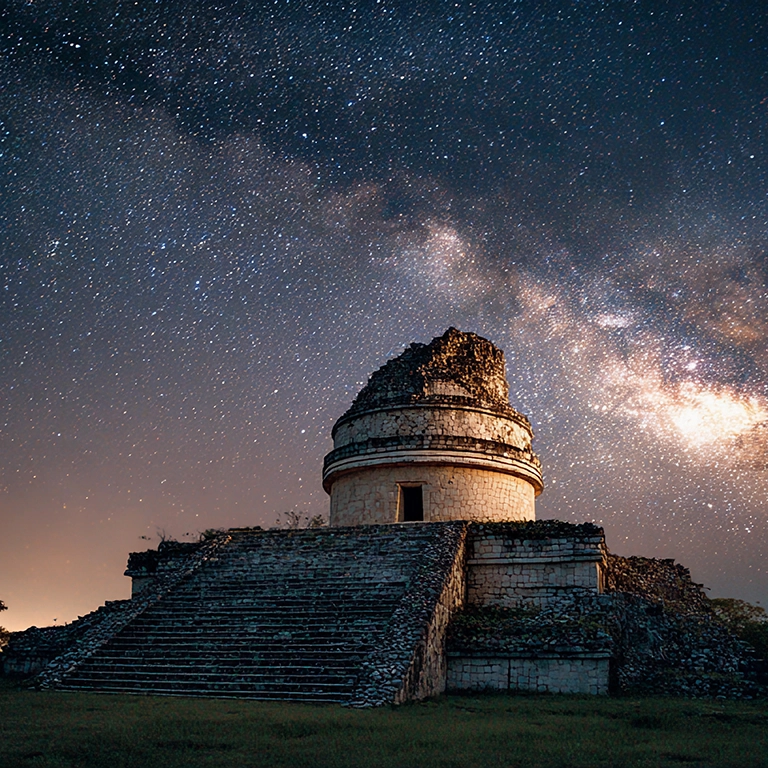
To speak of Chichen Itza is to speak of science, engineering, and the observation of the cosmos taken to an extraordinary level. Far from being a product of beliefs or myths, its constructions reveal that this civilization developed astronomical and mathematical knowledge capable of rivaling any ancient culture in the world. Its temples were not only ceremonial spaces: they were instruments for measuring time, the sky, and natural cycles.
A Calendar Carved in Stone
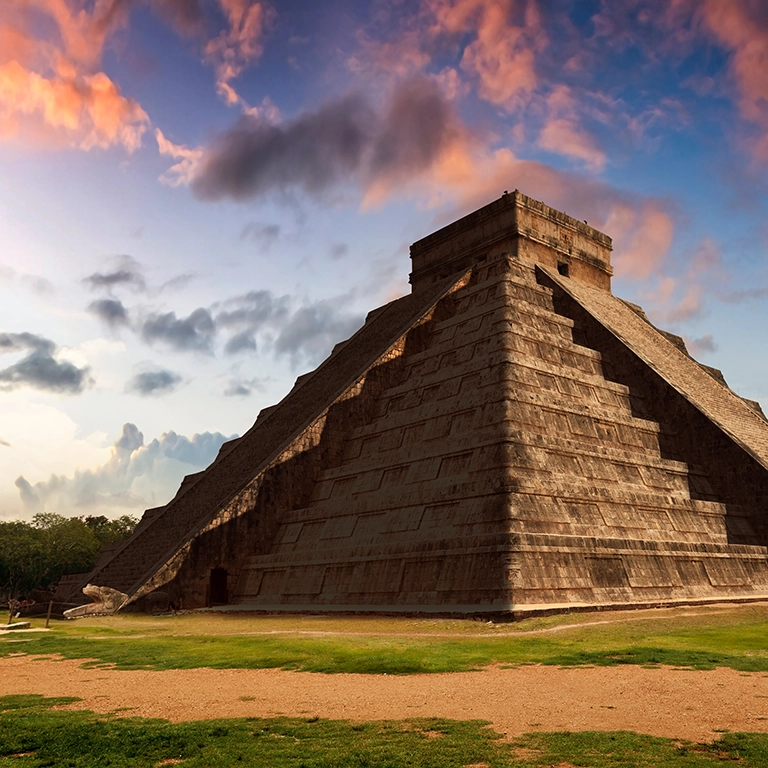
The most impressive example is The Castle, also known as the Pyramid of Kukulcán. This monumental structure functions as a perfectly calculated three-dimensional calendar:
- 365 steps, one for each day of the solar year.
- 52 panels, representing the 52-year Mesoamerican calendar cycle.
- 18 terraces, equivalent to the 18 months of the Mayan calendar.
None of this is by chance. Every proportion, every angle, and every orientation was designed with mathematical precision to synchronize the architecture with astronomical time.
Engineering Aligned with the Universe
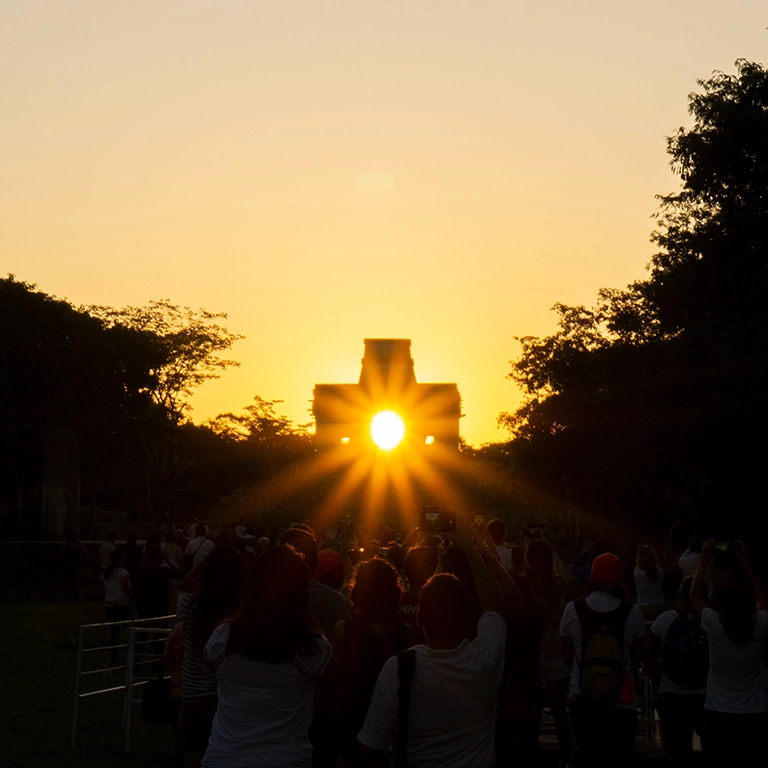
The pyramid is precisely oriented to the east-west cardinal points, demonstrating an advanced mastery of solar observation. Its tilt and geometry were calculated with such accuracy that they allow for a unique phenomenon: during the spring and autumn equinoxes, at sunset, the sunlight casts shadow triangles down the north staircase, simulating the descent of Kukulcán, the feathered serpent. This effect is not a visual accident, but the result of scientific planning that combines astronomy, optics, and architecture.
Science Before Myth
These details prove that the ancient Maya did not only observe the sky: they understood it. They knew how to predict solar cycles, calculate agricultural seasons, and record the passage of time with surprising accuracy for their era. Their constructions functioned as monumental observatories and permanent calendars, capable of maintaining synchronization with celestial movements for centuries.
A Legacy That Defies Time
Today, Chichen Itza continues to amaze the world because its precision remains unchanged. Every equinox, the interplay of light and shadow confirms that the science that made it possible continues to function exactly as it was designed more than a thousand years ago. It is a reminder that, in this ancient city, the architecture was not only built to be admired, but to engage in dialogue with the universe.